Everybody loves Nemo, so beginner fish keepers are often eager to have him swimming around their home aquarium.
Luckily, Clownfish are easy to keep and have simple diets compared to other saltwater fish. They are also amazing to learn about, with unique communication and biology. Each fish will bring personality in abundance, along with beautiful patterns and interesting movements, such as their ‘waddle’ while they swim. In this article we will talk you through how to care for them, what to feed them and their specific tank needs.
Category Rating
- Care Level: Easy
- Temperament: Peaceful
- Color Form: Orange, Black, White
- Lifespan: 6 Years
- Size: Up to 4″
- Diet: Omnivorous
- Family: Pomacentridae
- Minimum Tank Size: 20 Gallons
- Tank Set-Up: Marine: Coral or Rocks
- Reef Compatible (Safe): Yes
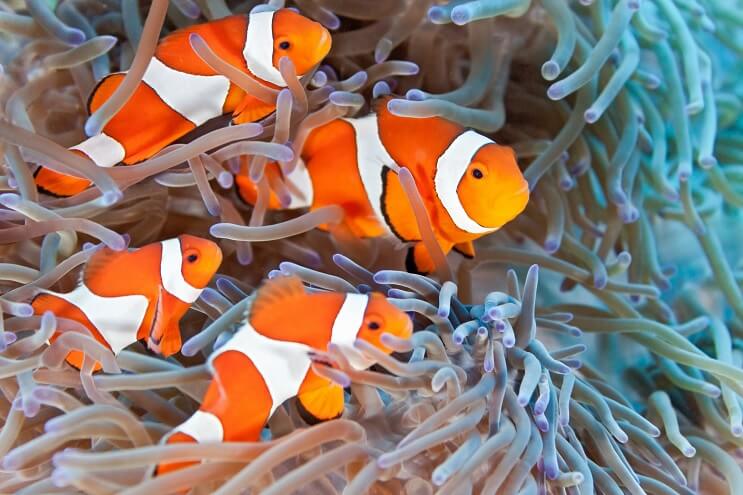
These bright little fish are many hobbyists’ first fish, making them a tried and tested beginner fish that brings personality and color to your aquarium. There are at least thirty species of Clownfish but two of them (most frequently called Orange Clownfish) are the most popular varieties. Their care needs are very similar, so this article will focus on caring for these two species. These are the Ocellaris Clownfish (Amphiprion ocellaris, also known as the False Percula Clownfish) and the Percula Clownfish (Amphiprion percula). All thirty species belong to the family Pomacentridae, which includes Damselfish. They will live for 6 years however there are reports of some species living longer. Clownfish cost around $15 and are usually available from aquatic stores that sell saltwater species as well as from online stores. They have an interesting group structure that often fascinates aquarists, where the dominant member of the group becomes the female and forms a pair with a breeding male.
Typical Behavior
These are peaceful fish that will only turn aggressive when another Clownfish species is present – this means that a tank can only have one Clownfish species. Living in the higher levels of the tank, they will often claim a small spot that has a weak current. They will leave this spot to be near Anemone if they are introduced, as this is where they would naturally find food. They are well studied because of their fascinating relationship with certain species of Anemone. A combination of being resistant to the toxins and the production of mucus that prevents the Anemones from stinging them, allows them to live together. To accommodate for their weak swimming, they need places to hide and feed.
Appearance of Clownfish
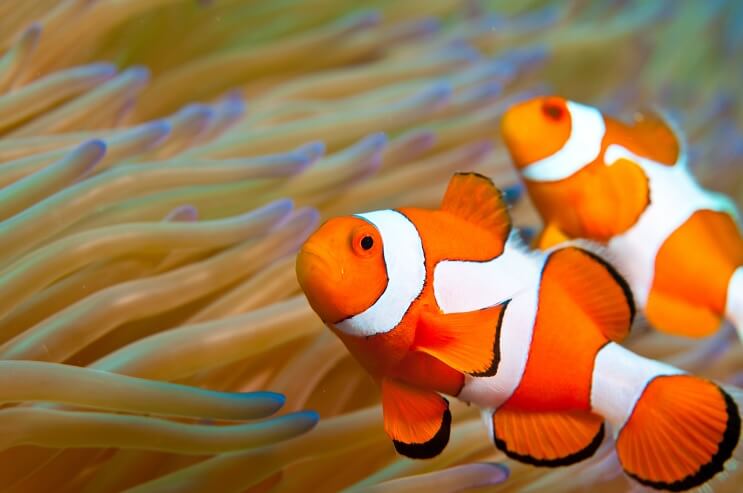
Clownfish have long bodies and a dip in their dorsal fin that makes it appear as if they have two fins and not one. The False Percula has 11 spines on their dorsal fins, compared to the True Percula which has 10 spines. These species will grow to around 4 inches but are typically smaller. This makes them an excellent size for smaller aquariums or beginner tanks. They have three white stripes: one behind the gills, one in the center of the body and one at the bottom of the caudal fin. The central stripe protrudes to create a more triangular shape pointing towards the head. Their stripes and fins often have a black outline which brings some real flare to them and makes their movements more enchanting. The False Percula will have thinner or no black outlines, which makes them bright in contrast to darker aquariums. They have a rounded caudal fin which is why they aren’t great swimmers. It is very easy for them to be over-powered by strong filters. True Perculas are most commonly orange, but natural black varieties can also be found. Some rare color morphs have also been bred to create varieties such as platinum (which is almost completely white).

